

Forums › Forums › Technical Articles › Science of stock design
-
Science of stock design
Posted by Iceshooter on August 28, 2011 at 7:46 pmAs I could not find this on the web I post the question here.
Whats the science behind different stock design? Im mainly interested in the concept of pistol grips and thumbholes vs “traditional” design.
Thanks
chad replied 15 years ago 6 Members · 8 Replies -
8 Replies
-


EJG is a stock designer on the site and makes some incredible composite and carbon fiber stocks for the T3.
Some of his comments can be seen here: https://tikkashooters.com/public_html/index.php/topic,228.0.html
Hopefully he chimes in here can add more to the discussion.
-
Almost all competetive shooters shoot with the thum on the right side or just up.
So the idea behind thumbhole is in my opinion not very good at all, it's just hoax.What i feel is extremely important though is
1. Buttplate height (usally its to low, on all montecarlo stocks its far to low as it's lowered 1-2″ from where it should be.
2. Stocklenght (different shooting positions, diffrerent clothing calls for different stocklength, sadly here is no civlian good solution for this)
3. Cheekpiece height is often far to low.For a General hunting gun and a gun used for driven game I like a pistolgrip that is very slope, 45 degrees is great.
For a long range snipergun where prone is the most used posisiton a vertical grip is great.So ideally a stock should have a mechanical device for adjusting LOP, buttplate height and cheekpiece height.
This device should ideally be possible to manipulate without the use of tools and preferably with one hand.Håkan
-
Hakan has good points and I for one don't see the sense in the thumbhole
stock, maybe because I hunt mostly and often swivel the rifle off the
shoulder to take a quick shot.I believe the barrelled action starts moving the moment the bullet starts moving. This
means we should think of controlling where and how the barrel is moving and how
we can influence it. A rifle that has no muzzle flip will be nicer to shot…at running game
or prone long range. This leads to the story of centre of mass in relation to the line of the bore.
Another issue is the stiffness of the action stock connection, no use having a mighty
stiff stock if your rifle is just screwed onto and into some micro-balloon filled epoxy with no
structural connection to the shell and mass of the stock. The connection will alter the
harmonics or at least dampen somewhat. Better would be to have the inlet structured
ultra stiff and strong to relay the recoil directly into the shell of the stock without flex.Another area we are working on is to increase the thermal conductivity of the inlet area
of the stock to help transfer heat away. This coupled with trying to blend a composite that
has similar thermal expansion as steel.Stock shape: most factory stocks, especially plastic stocks are made to a price. A smaller
stock uses less material and can be possibly moulded on a smaller machine with lower
clamping force. Most factory stocks must be usable with open sights which means low
comb and mostly also low butt pad position.
I had great fun butchering around hunting stocks and finding a best compromise
hunting stock shape. A few of my shooting friends were involved. Firstly we raised the
comb so high, that a cleaning rod will just slide in. We made the pistol grip much longer
than average and curved, meaning hand forward off-hand the angle is flatter and
prone with the hand slightly further down the pistol grip it is steeper. The forend
we left square shaped, swing up a rifle fast and the hand on the forend feels
the horizon. Less chance of pulling up a rifle canted. Our T3 stock was shaped late
last year and has the butt pad positioned 10mm higher than our other stocks which
are fairly high anyway.
We are working on a tactical stock at the moment which will have an almost straight
pistol grip and a bit longer than most others. We added a “memory shape”, meaning
the front of the pistol grip and left/right will have a light triangular line running down.
These lines will give the shooter a reference of hand position, similar effect as the shape
of a tennis racket handle that tells the player “which position his racket head is at”.
I have built tactical stocks before that weighed around 800 grams and we hope to be able
to be under 850 grams with our new E-tac including adjustable cheek.
Generally I think once we have a very light weight strong and stiff stock, we can
add weights exactly where needed to improve the way our rifle shoots. In the end
we might have a rifle the same weight as with conventional methods, but it will
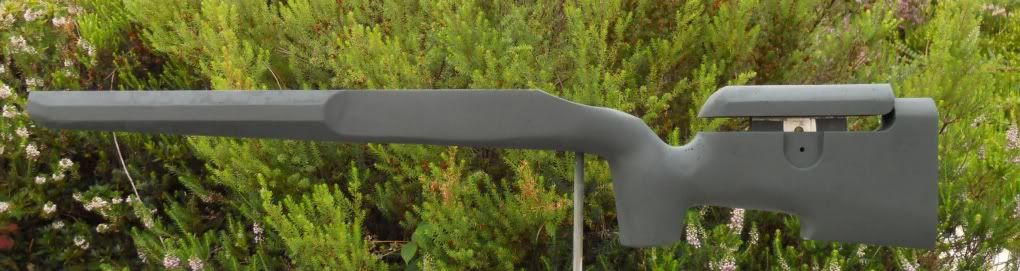
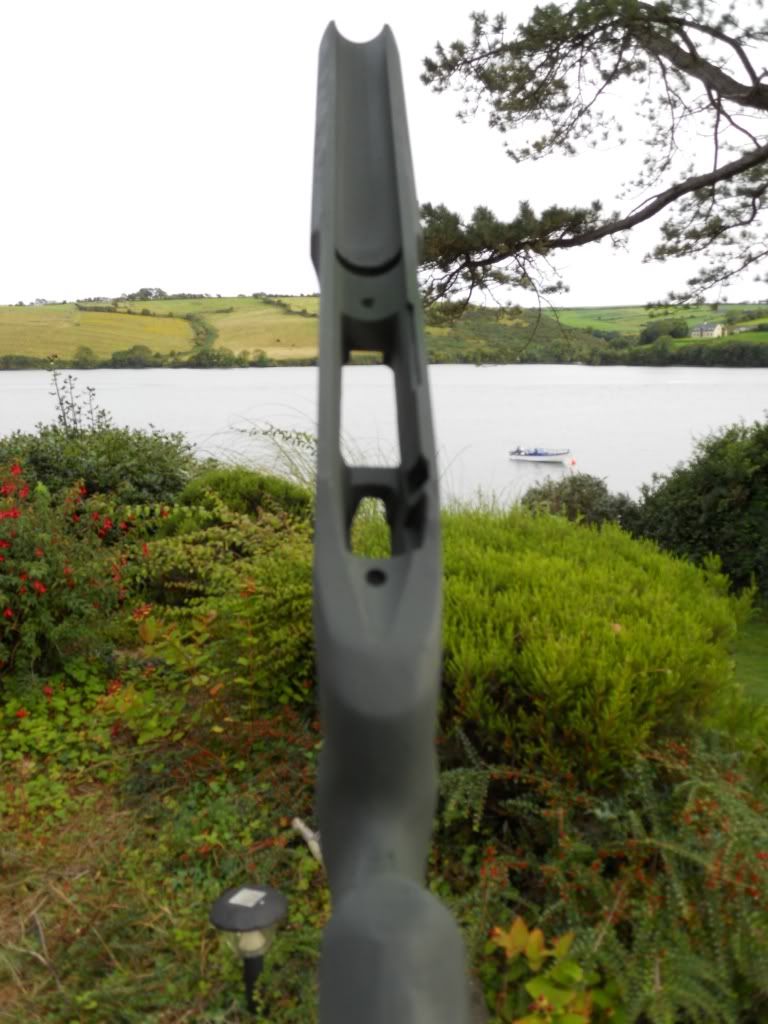
behave much better under recoil which will hopefully lead to better accuracy.pic of our E-tac prototype. Shape is somewhat altered in the mean time.

edi
-
Very nice stock design!! Would this incorporate the stock aluminum recoil lug or would it be supplied with a steel one?
-
Very nice stock design!! Would this incorporate the stock aluminum recoil lug or would it be supplied with a steel one?
thanks,
Our T3 hunting stock comes with opening to fit the original aluminum recoil lug or a steel aftermarket lug.
The E-tac will be made with a Remmy SA style inlet first and a T3 version will hopefully follow early next year.
Good point with the recoil lug, might be an idea to supply a steel lug with a stock that can be glued in while bedding.
Not too good having a fixed recoil lug in the stock before bedding.
edi -
In regard to your question on pistol grip and thumbhole design it all boils down to a vertical grip.
In the competition style stocks such as our Competition/Tactical and F-class stocks the Vertical grip allows you to bring you shooting elbow downward and have a more relaxed wrist which lends to a more stable position and better trigger control. Trigger control is fundamental to shooting and cannot be taken out of the equation when accuracy is the goal. The downward elbow naturally places the shooting hand elbow in contact with the ground while in the prone position which is vital to a steady position and again is a fundamental and cannot be ignored when shooting. The pistol grip design really lends itself best to prone and benchrest style shooting.
In thumbhole designs such as our Thumbhole/Tactical and Thumbhole/Sporter it again comes down to a vertical grip. The grip on a thumbhole stock is not as vertical as a pistol grip stock but it is definitely more vertical than say a standard classic or monte carlo design. The thumbhole grip fills your hand and allows for a more comfortable and more stable grip which again lends to a more stable hold and better trigger control. While the grip is more vertical than standard style stock it is not so vertical that it requires you to completely drop your elbow like a pistol grip so the thumbhole really shines in offhand shooting. Also the more vertical grip positions the hand in a manner that allows you to reach and cycle the bolt handle faster.
I hope that helps.
Chad -
Hi Chad,
Welcome to the forum! I love the fact that we have excellent stock designers here that can help us all better understand the method behind certain styles of stocks.
You can see Chad's designs in our Tikka Store at http://www.tikkaperformance.com
Most of the product lines are not uploaded yet, but Chad's stocks are there.
-
Hey Jason,
Happy to lend my 2 cents on the subject.



Log in to reply.